Building a powerful upper body from home is no problem. You can do it with calisthenics, a kettlebell, or a couple of dumbbells.
But building powerful legs at home is more difficult. And building powerful glutes? That’s a real challenge.

We’re used to carrying our weight on our legs all day, so bodyweight movements alone often don’t present a huge challenge. Getting a power rack for the home is tricky unless you have lots of available space and funds. Moves like pistol squats are limited by technique and mobility. And many leg exercises just feel awkward to perform, especially with lighter weight and higher reps.
Enter the step-up: one of the most slept-on and overpowered leg exercises around for building functional strength in the lower body while also developing powerful glutes and quads.
The step-up is a highly functional and practical movement that we use in our daily lives. It’s simple and fun to perform, and it develops the legs in ways that often get overlooked.
This is a form of single leg training that offers a moderate stability challenge and adds resistance for the glutes in a stretched position. There’s no discomfort and it can be challenging even if you don’t have access to a massive barbell.
SUPERFUNCTIONAL 3: SUPERMOVER - SPRING SALE!
Supermover is a program that builds an athletic physique and functional performance with short, accessible, & fun home workouts.
GET SUPERMOVER HERE!
Here’s what you need to know.
How to Perform the Step-Up (And What Most Get Wrong)
To perform a step-up, you’re simply going to take your chosen weight – I often use a kettlebell – and hold it in front of you, goblet style. Alternatively, you can hold a dumbbell or kettlebell in either hand and have them dangle by your sides.
Now you’ll need something to step-up onto like a bench, a stool, a chair, or a step.
You can start with a platform around knee height or just slightly below. As you progress, you should increase this to thigh-height.

Right away, this is something you don’t hear all-too often. The recommendation is very often to find a knee-height platform. This is fine – but going higher means you’ll train the glutes in a more stretched position. This is crucial as research increasingly shows that this is where the majority of hypertrophy takes place.
While any raised surface will do nicely, I personally enjoy using a step ladder that I bought for this explicit purpose. It’s a three-step ladder that I can easily fold away when not in use and it’s rated for up to 150kg, so I should be fine with my 20-40kg dumbbells.
Once you’re in position, you’ll plant one foot on the step then drive through your glutes by pushing through the heel to raise the floating leg to the same level. Do not push off of the floating leg – it’s simply along for the ride.
As you do this: try to keep the body as straight as possible – avoid leaning your torso forward. You want to learn that your posture doesn’t need to collapse when you climb up onto a large step.
Likewise, try to keep your hips as level as possible.
Keep the planted foot straight and try not to let the knee collapse inward or outward. A caving knee will not only reinforce bad movement patterns, it will also reduce activation of the glutes, AND it could lead to injury. So, keep the knee stacked over the ankle.
When you’re at the apex of the movement, your free leg should be the same height as the working leg and you can then lower yourself back down. If you do this in a slow and controlled manner, you’ll be building additional eccentric leg strength and control.
Do not switch legs at the top of the platform! Some people do this and it’s absurd; it’s a bit like doing a bicep curl and then passing the dumbbell to the other hand before lowering it!
Once at the bottom, though, it’s up to you. You can perform the next rep on the same side again if you want to maintain tension on the leg and build more muscle. OR you can alternate if you want to use this more like a conditioning workout.
And don’t be afraid to get creative with it: you can train step ups simply by going up your own steps two at a time and that way you can take multiple steps with each rep! If you walk back down, it becomes a concentric-only movement – which leaves out the eccentric portion of the movement entirely. This reduces total mechanical tension BUT also lets you train harder and more frequently with minimal recovery time for an insane stimulus to fatigue ratio.
Why the Step-Up is Perfect For Building Glutes at Home
I’ve heard some coaches recommend pushing through the quads. And it’s true that this can be one application of the step-up. It’s not wrong, per-say, but it turns the move into a glorified leg press.
To me, this defeats the whole benefit of the movement: this is a very rare exercise that loads the glutes in a unilateral movement that’s relatively stable and allows you to add a decent amount of weight. What’s more, is it allows you to train this at a stretched position – making this a viable alternative to a barbell hip thrust or a deadlift that you can perform from home with minimal equipment. As I alluded to at the start of this post: it’s actually very tricky to train the glutes from home
This is a huge benefit in my opinion, and I think it’s a shame that most instructional videos and articles seem to miss that point.
I’m the best, is basically what I’m sayng…
The Step-Up As GOATED Single-Leg Exercise
The step-up is a single leg exercise. Training on a single leg is fantastic for developing balance and stability and allows us to work stabilising muscles like the quadratus lumbuorum. Weak QL muscles can lead to issues like back pain, and stiff awkward gait and other movement.
In short, single leg training with moves like the step-up, encourages great walking mechanics by controlling hip hike and keeping everything level and stable, even with uneven loads.
To ensure you’re getting these benefits, make sure that you focus on keeping the hips as level as possible throughout the movement. You can load the weight on just one side if you want to add further to the unequal nature of the move.
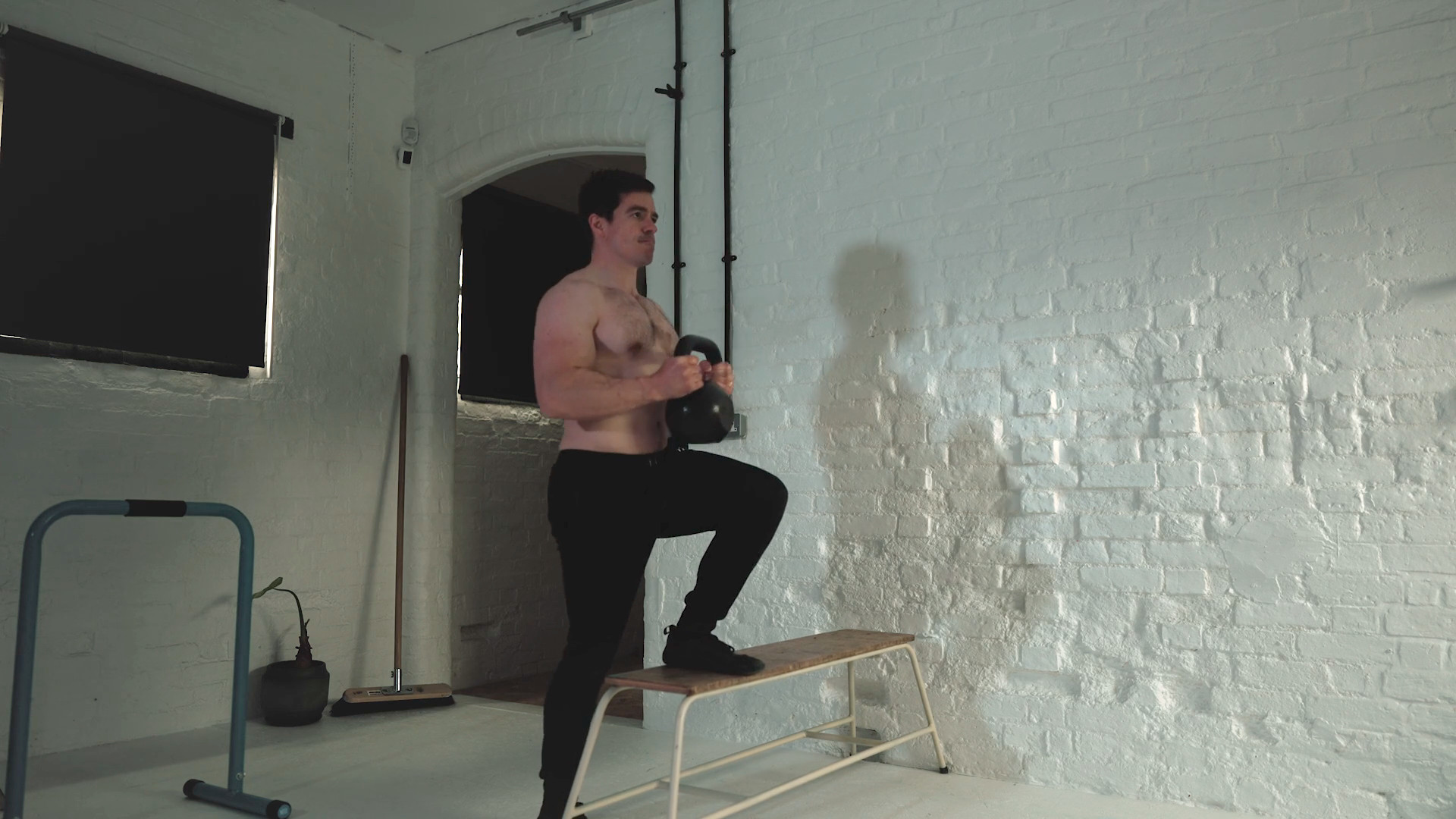
Remember: when we jump in the real world, we do it off of one leg 90% of the time. We harp on about standing vertical jumps but any freerunner, basketball player, or track athlete will very rarely jump this way.
Speaking of which: another variation is to keep pushing all the way through at the top of the movement and turn this into a jump. You’ll want to use little to no weight for this variation, at least to begin with. You can also practice leaping straight up in the air, or propelling yourself forward, which will slightly alter the muscle activation. Now you’re really mimicking a very athletic movement.
Alternatively, just bring the other leg up and through to raise the knee at the top of the movement, for a simpler version. Just make sure you’re stable and not likely to lose balance. If balance is an issue for you, you can of course load one side a place your free hand against a wall.
Even if you’re focus is not on athleticism, single leg training helps you avoid imbalance and develop both legs equally. All of us have a dominant leg and this tends to affect the way we stand, walk, and run. While that’s normal to an extent, it can become a problem in some cases and lead to impaired performance and even pain.
Unusually, this can be more of an issue for very athletic individuals who train and perform at high levels – exacerbating a pre-existing side bias. A regular back squat can hide this sort of imbalance, as you quietly create more force through one leg without realising. With step-ups, there’s nowhere to hide.
Pro tip: perform on the weaker side first and then match the number of reps on your dominant leg.
How the Step-Up Builds Amazing Mobility
Finally, you can also use the step-up as a more mobility-focussed movement. Find a high platform – you can go up to your hip or higher – and lower the weight.
To get more from this, even with a lower platform, try lowering your hips after you plant the working leg, before driving through and stepping up (lower in this instance by bending the knee of the floating leg).
This additional dip will deepen the ROM even if you don’t have a very high step – creating a very satisfying deep stretch for the hip flexors, glutes, and rectus femoris.
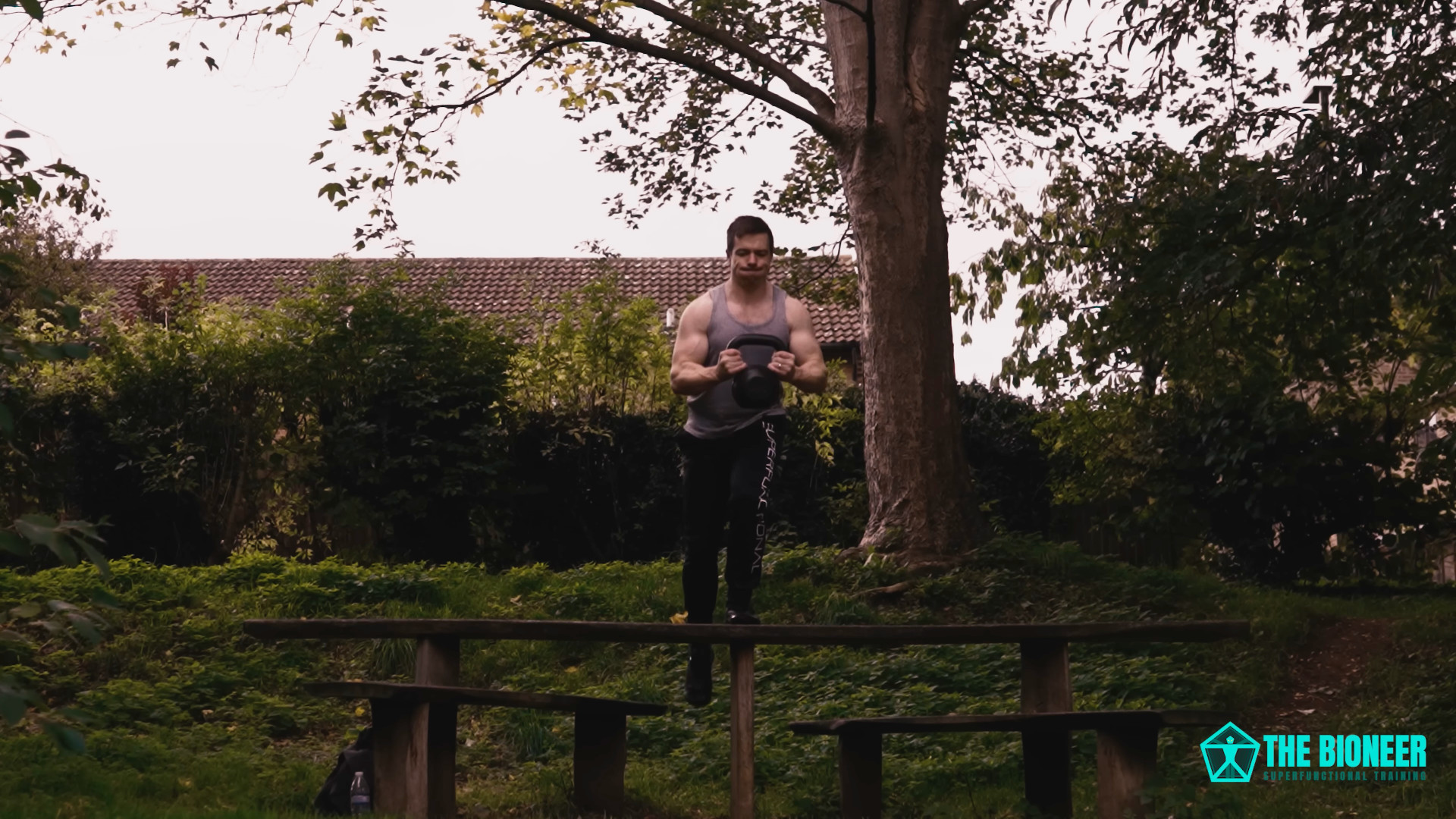
For added points, lean forward more so that the knee comes past the toe – not by making the body less upright but by bringing the pelvis closer to your working foot. This way you’ll be training your ankle mobility (which is crucial for deep squatting, quiet landing, and more) and you’ll also be strengthening the tendons in the knee along with the VMO and bulletproofing the knee. In this way, it works similarly to an ATG split squat.
Why the Step-Up is TRULY Functional
What makes the step-up so awesome is that we actually use it in the real world but rarely train. It has many of the same benefits as a loaded carry or a farmer’s walk – because that’s essentially what it is! Except it adds more resistance and challenge to the movement.
So, whether you’re getting older and you want to feel safe and stable going up stairs with bags, whether you’re someone looking to build bigger and more powerful glutes from home, or whether you’re a free runner who needs to quickly leap off of an object as you run to gain extra height… this movement makes you stronger, more powerful, more resilient, more dynamic, and more athletic.